August 20, 2025
Dr. Fiona Reynolds Named 2025 Children’s HeartLink Founders Award
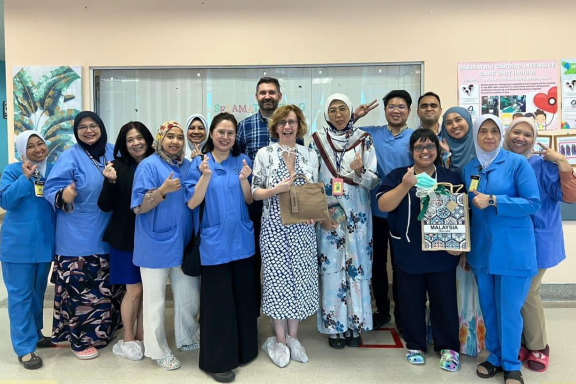
Pictured: Dr. Fiona Reynolds (center) winner of the 2025 Children’s HeartLink Founders Award with the heart care team at Hospital Sultan Idris Shah in Malaysia, fellow volunteers from Birmingham Children’s Hospital and Children’s HeartLink staff.
When Dr. Fiona Reynolds was only eight years old, she knew that medicine was her calling. After watching a TV doctor named Quincy, a medical examiner who solved mysteries after death, she knew she would become a doctor.
“I’m far better with the living,” she said now with a smile, after decades spent saving lives and teaching others to do the same.

Dr. Reynolds is a pediatric intensivist at Birmingham Children’s Hospital in the UK. She is the recipient of the 2025 Children’s HeartLink Founders Award, which recognizes an individual involved in the mission of Children’s HeartLink who has shown extraordinary dedication to improving pediatric heart care services in underserved part of the world. The award was established in honor of Children’s HeartLink’s founder, Dr. Joe Kiser.
Learn More About the Founders Award
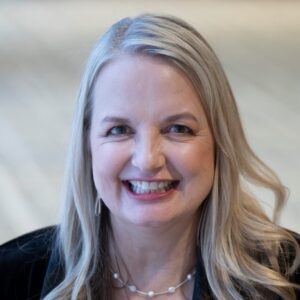
Pictured: Dr. Fiona Reynolds (left) winner of the 2025 Children’s HeartLink Founders Award, with Dr. Geetha Kandavello at Institut Jantung Negara (IJN), a Children’s HeartLink Center of Excellence, in Malaysia.
Caring for critically ill children requires a team effort
In the world of pediatric cardiac care, an intensivist like Dr. Reynolds manages life support for children before and after heart surgery. The work is meticulous, demanding constant collaboration from multiple disciplines that make up the heart care team.
“We don’t do this work alone,” Dr. Reynolds said. “Intensive care doesn’t happen without resident doctors, intensive care unit (ICU) nurses, physiotherapists, pharmacists and more. In a pediatric ICU, there are usually twice as many adults in the room as there are children.”
Meet Dr. Reynolds at the Children’s HeartLink Global Gathering. 
Training partnerships in Malaysia transform heart care for children
Dr. Reynolds has brought this understanding of the important role of multidisciplinary care with her as a Children’s HeartLink volunteer in Malaysia. From the very first assessment visit to Institut Jantung Negara (IJN) back in 2007 to when it became a Children’s HeartLink Center of Excellence in 2016 to today.
Since that first visit, Dr. Reynolds proudly shared that, “I’ve only missed one Children’s HeartLink training visit to Malaysia.” The progress that has been made toward improving pediatric heart care in the country is remarkable.
One of the key relationships Dr. Reynolds has nurtured over the years is with Dr. Sivakumar Sivalingam, senior consultant cardiothoracic surgeon and clinical director of pediatric surgery at IJN. Even before IJN became a Children’s HeartLink partner, Dr. Siva trained at Birmingham Children’s Hospital. That early connection helped lay the foundation for the close, collaborative partnership that followed, allowing the partnership to strengthen and produce lifesaving results.
“In the beginning at IJN, they couldn’t do complex neonatal surgeries, the very surgeries we considered routine in Birmingham,” Dr. Reynolds said. “The Children’s HeartLink partnership helped them along the learning curve. Now, they’re doing hundreds of operations each year on babies who wouldn’t have survived before.”
Today, she volunteers alongside colleagues from Birmingham Children’s Hospital at another Children’s HeartLink hospital partner in Malaysia, Hosptial Sultan Idris Shah (HSIS) in Sepang (formerly Serdang Hospital), supporting the next generation of pediatric cardiac expertise in the country.
“[Dr. Reynolds is] very helpful and diligent in helping us transform the intensive care management to be on par and within the recommended standards of how an intensive care unit should be functioning,” said Dr. Ghee Tiong Koh, pediatric cardiologist, and Dr. Norliza Ali, pediatric cardiologist, at HSIS. “She also helps us recognize our strengths and weaknesses and how to overcome hurdles and crises in an intensive care set up.”
Having worked alongside Dr. Reynolds for many years in the Malaysian partnership, Andreas Tsakistos, country director and technical advisor at Children’s HeartLink, emphasized the foundational role she has played in developing pediatric heart care in the country.
“She lends her support to local teams with knowledge, trust and the building of confidence. The relationships she’s built in Malaysia have grown children’s heart care expertise that will impact future generations for years to come.”
Hands-on learning is key
Since Children’s HeartLink began partnering with hospitals in the country, nine Malaysian intensivists have trained with Dr. Reynolds and her team in Birmingham, with another scheduled to begin soon. She emphasized the importance of first-hand, practical learning to gain expertise.
“Until you’ve been in a multidisciplinary ICU, you don’t understand how busy they are,” she said. “Dietitians, physical therapists, pharmacists… you can only see it when you’ve seen it with your own eyes.”
Dr. Reynolds has also shared her expertise with the government of Malaysia, participating with Children’s HeartLink in policy conversations around heart care and children with the Malaysian Ministry of Health.
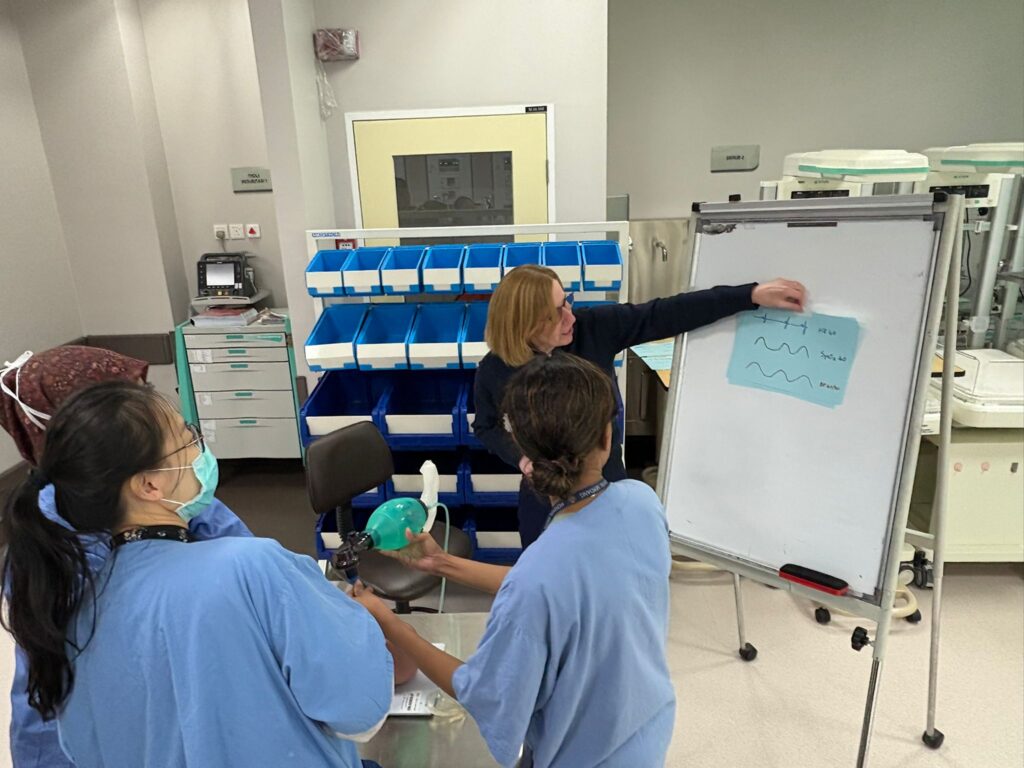
Pictured: Dr. Reynolds providing cardiac ICU instruction during a January 2024 training visit at HSIS in Malaysia.
Challenges facing children’s cardiac care, and the way forward
Many challenges continue to face heart care teams in Malaysia, Dr. Reynolds explained. Too few pediatric heart specialists. Nurses lost to higher-paying jobs in other countries. Children waiting longer than ideal for surgery due to staffing shortages and limited operating room access.
“If the optimal time for surgery is when a baby is just days old,” she said, “in Malaysia they might have to wait a month. Toddlers may not get surgery until they’re school-aged. And it’s not because the doctors aren’t good. It’s a matter of capacity.”
This represents one reason why Dr. Reynolds has championed the Children’s HeartLink sustainable training model so strongly.
“The beauty of Children’s HeartLink is that it’s always been about teaching,” she said. “What we’re doing is experiential learning. Practical learning. Coaching brings teams up the learning curve dramatically. When you think about top athletes, they know that every gain matters. To help a team become great, you have to coach them in the details – the marginal gains. Whether you go there or they come here, coaching lifts the entire team up.”
“I couldn’t consider not going now.”
Dr. Reynolds has found joy and connection over the almost two decades she has volunteered with Children’s HeartLink in Malaysia.
“I learn so much when I go to Malaysia,” she said. “I’ve made many, many good friends. I couldn’t consider not going now.”
And while her work with Children’s HeartLink has changed the lives of thousands of Malaysian children with congenital heart disease, she’s quick to credit Children’s HeartLink supporters for making her work possible.
“It doesn’t happen without them,” she said. “18 years ago, IJN couldn’t do many neonatal surgeries. Now they can. Quite literally, supporters have saved the lives of children in the countries where we’re training. Families are kept together. Children can grow up to become productive members of society, rather than dying because of a heart condition.”
Every year 5,000 children are born with congenital heart disease in Malaysia. With limited pediatric heart programs, many who need surgery never receive it.
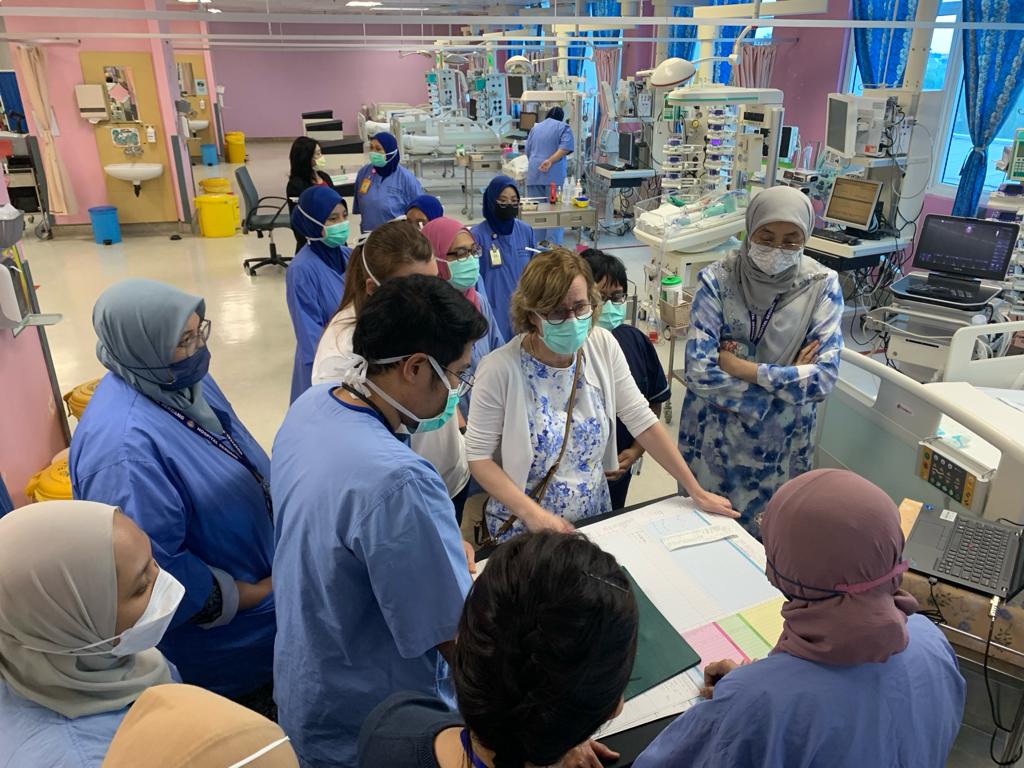
Pictured: Dr. Reynolds and team at HSIS in Malaysia during a Children’s HeartLink training visit.
Envisioning a future of shared learning available to all heart care teams
Dr. Reynolds envisions a future where global learning becomes even more connected to reach even more children.
“I’d like to see a world where no doctor feels cut off from the learning community,” she said. “This is something Children’s HeartLink does absolutely well.”
For her, volunteering her time and expertise is as much about equity as it is about her personal call to do the right thing.
“I enjoy it,” she said. “I’ve got time. And I believe we can build a more secure world if we look after the most vulnerable and help each other.”
Dr. Reynolds is also widely known for her role in saving the life of Nobel Peace Prize laureate Malala Yousafzai, who was treated at Birmingham Children’s Hospital after surviving an attack in Pakistan. While her name is often associated with Malala’s story, Dr. Reynold’s impact on the world can also be measured by the lives of Malaysian children with heart disease that have been changed and saved, as well as in the heart care teams she’s helped build to serve them.


