May 6, 2026
Creating the Ripple Effect in Global Nursing Education
Stepping into Nursing Education

By chance, her manager, Anna Fisk, was already a longtime Children’s HeartLink volunteer. She recommended Erin meet with Country Director Adriana Dobrzycka and VP of Global Strategy and Advocacy Bistra Zheleva.

Erin Babine (first row, right) at her first training visit with Bangladeshi nurses and medical volunteer nurses from Leeds Hospital, U.K.
A project was quickly identified. The medical volunteer team from Leeds Children’s Hospital, U.K., was seeking additional support to provide nursing education to their partner team at National Heart Foundation Hospital and Research Institute (NHF) in Dhaka, Bangladesh. Erin jumped on board to develop a hybrid model to train the Bangladeshi nurses online between on-site training visits.
“I had access to Boston Children’s resources for education, like nursing orientations and new graduate nurse classes,” Erin’s eyes sparkled with excitement. “And with my prior global health experiences and knowledge, I could cull information, so it’d be relevant [to the NHF team].”
In October 2023, Erin flew to Dhaka, Bangladesh to join Leed’s training visit and meet NHF nurses for the first time. She learned more about the education the nurses were seeking to support children undergoing congenital heart disease surgery and the management of their care. With Erin and the Leeds team, the NHF nurses identified they first needed knowledge on anatomy and physiology, the ability to identify complications and when and how to intervene.
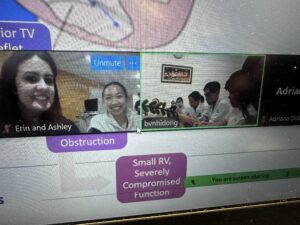
Erin Babine and students during a virtual training class.
“Trying to engage and educate nurses online may not work. Nurses function differently in every country,” Erin explains. “The expectation for how nurses’ function [and contribute on a team] in the U.S. is much higher than other places, where nursing education often isn’t even a thing.”
Nurses are often the closest team member to a child and their family after heart surgery, positioning them to deliver patient-centered, personalized care. Yet in many underserved countries, academic nursing programs do not adequately prepare them for the complexities of pediatric cardiac care.
So, Erin aimed to develop and implement an 8-month online education series that resonated with the team. It worked—exceedingly well! By the end, an average of 20 to 30 NHF nurses would attend monthly sessions held from 1 A.M. to 3 A.M. EST.
“I’m a permanent night nurse by choice. But this means I can run classes when it’s daytime for the nurses in Bangladesh, which is not the usual for them. They’re often the ones getting up in the middle of their night to attend trainings held during our daytime,” Erin marvels.

Starting a New Ripple
It’s not the only choice of hers that’s proved beneficial to working in global health.
Erin’s also a CPR instructor with the American Heart Association. During her first visit to NHF, she also noticed this skills gap. She started teaching the nurses how to do CPR, then a doctor’s component was added. She first taught the skill with the Leeds team, then since the spring of 2024, Erin led all CPR trainings herself. By the end of her fellowship, she trained 29 nurses and 8 physicians on Basic Life Support skills, where the doctors then trained other NHF clinicians on these skills.
Uniting Nurse Training and Improving Care
This progressive rippling effect is a defining characteristic of Erin’s work and Children’s HeartLink’s train-the-trainer model.

Erin Babine (center) with Boston Children’s nurses preparing for a virtual training session.
As her fellowship was ending, Erin returned to NHF where she had now built a rapport with the nurses and the ICU team. During her visit, the nurses asked her to provide them with training on the different congenital heart diseases—they wanted to understand how to better care for patients with varying heart conditions. As Erin was developing this series a similar request came to Children’s HeartLink from nurses at Nhi Dong 1, a Children’s HeartLink Center of Excellence in Vietnam.
Their interest made one thing clear: the demand for basic knowledge and education in specialized pediatric cardiac care was desired and growing.
Shortly after connecting with the Vietnamese nurses, Erin’s fellowship ended and the time and resources she could devote to this project were no longer available. She wasn’t sure how to keep her classes going.
Giving it some thought, Erin realized the training she wanted to provide for Bangladeshi and Vietnamese nurses can also be used as a tool to educate emerging pediatric cardiac nurses at her own hospital. This is because there are always new staff members to the pediatric cardiac ICU at Boston Children’s Hospital who would also benefit from strengthening their knowledge and application to clinical practice.


Erin Babine and Liz from Boston Children’s Hospital with nurses from NHF during a virtual training session.
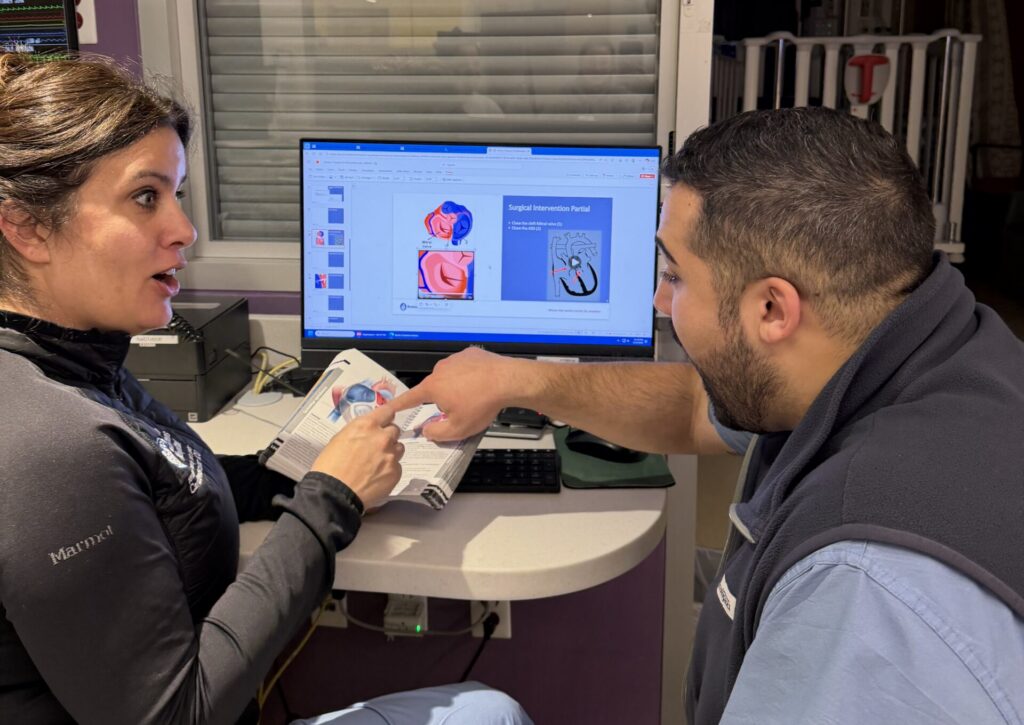
With support from Boston Children’s Hospital, Erin created a plan to include Boston Children’s nurses in the training classes she was offering nurses from Bangladesh and Vietnam. The Boston Children’s nurses would join sessions from their bedside while in the room with Erin.
But with multiple languages in the mix, translating from English to both Bengali and Vietnamese takes a bit of time, which created pauses in the presentation for American nurses. To help with this, Erin invited the U.S. nurses in training to co-teach with her.
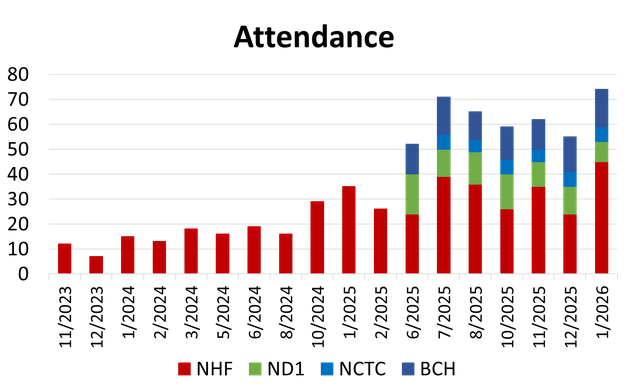
Attendance of nurse education students over time by hospital partner.
This changed the dynamic for the U.S. nurses and added an extra learning opportunity for the Bangladeshi and Vietnamese nurses. Not only can the partner site nurses experience what it’s like to learn from peers, but also experience a peer-to-peer teaching method to continue training each other outside of Erin’s classes and hospital visits from medical volunteers.
Nurses and physicians have shared that the impact of both nursing education initiatives has been incredible. “Both our nursing staff and I find the monthly Zoom classes extremely helpful,” says Chau Nguyen, a physician from Nhi Dong 1 in Vietnam.
Erin’s nursing classes now sees regular attendance of at least 50-60 nurses from Bangladesh, Vietnam, Ghana and the U.S. For the U.S. nurses, confidence in their knowledge and ability to answer questions about various topics has increased.

Future Evolutions
This project’s evolution continues to astonish Erin. What began as a way to fill a critical learning gap for nurses at a partner hospital has now taken on a life of its own.

Erin Babine waving into her camera during class.
“I can see the sustainability of Children’s HeartLinks’ programs. It makes the work so satisfying,” Erin reflects on her partnership with us and how much she values our training and education focus. “I can tell all my hard work is paying off. The nurses, over time, are asking questions—there’s momentum and engagement. [The classes] are helping them with their work. Now people are starting to notice the impact of this project and are encouraged by it.”
A smile of contentment breaks across Erin’s face.
“I never thought of myself as a nurse educator,” Erin admits, grinning widely at this unexpected turn of her career. “I never thought I would be doing this, but I’ve been enjoying this so much. I may want to do more of this as an actual job…training and education that is.”
Nurse education and development are critical to improving care for children born with congenital heart disease. Your gift to support nurse training initiatives like this will provide lifesaving care to children in need.


